

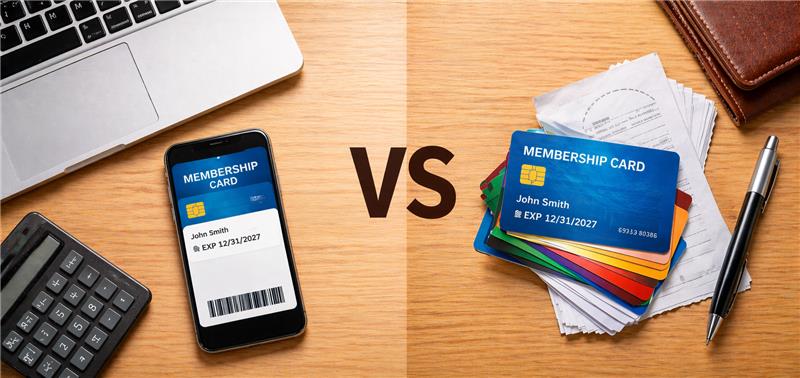
This post breaks down the true cost of physical membership cards including the expenses most organizations forget to account for and compares them honestly against modern digital alternatives. By the end, you’ll have a clearer picture of what your program is actually spending, and what you could save.
The visible costs of physical cards (and the hidden ones)
When most membership managers think about the cost of a physical card program, they think about printing. That’s just the beginning.
1. Design and setup fees
Before a single card is printed, there are design costs to consider. Custom artwork, logo preparation, and layout approvals can add $150 to $500+ to your first order, and setup fees for plate creation or file prep are often charged again if you update your design even slightly.
2. Per-card printing costs
The cost of the card itself varies widely depending on material, print method, and quantity. Here’s a realistic range based on current vendor pricing:
| Card type | Price per unit (small run) | Price per unit (bulk 5,000+) |
|---|---|---|
| Basic cardstock | $0.10 – $0.30 | $0.05 – $0.12 |
| Full-color PVC (single-sided) | $0.50 – $1.25 | $0.20 – $0.50 |
| Full-color PVC (double-sided) | $0.90 – $2.00 | $0.35 – $0.80 |
| PVC with magnetic stripe | $1.50 – $3.00 | $0.60 – $1.20 |
| PVC with RFID / smart chip | $3.00 – $8.00 | $1.50 – $4.00 |
For most membership programs, a full-color PVC card with a barcode or magnetic stripe is the minimum requirement. At 1,000 members, that’s $500 to $3,000 just in card materials before anything else.
3. Postage and mailing
Physical cards have to get to members. A standard first-class letter with a card typically costs $0.73 or more per piece in postage alone, plus the cost of envelopes, any welcome inserts, and staff time to stuff, seal, and sort. At 1,000 members, postage alone runs $730 or more and that’s before adding replacement card mailings for members who lose or damage theirs.
4. Rush fees and reorders
Standard production runs five to ten business days. Need cards faster? Rush fees of 20% or more are common. And when a new member joins in the middle of your print cycle, you’re either waiting on a minimum order quantity or paying a premium for a small rerun.
5. Staff time
This is the cost almost no one tracks. Consider how many staff hours go into managing a physical card program each year:
- Preparing and approving artwork for each annual reprint
- Placing and tracking orders with print vendors
- Processing and mailing new member cards
- Handling replacement card requests (lost, damaged, or expired)
- Manually updating cards when membership tiers or benefits change
At even a conservative $20/hour, five hours per month of card administration adds $1,200 per year to your program costs and many organizations spend significantly more.
The real cost of a physical card program isn’t just what’s on the invoice. It’s printing + postage + design + staff time + reorders + replacements compounded every year.
What digital membership cards cost
Digital membership cards live in a member’s Apple Wallet or Google Wallet. There’s no plastic, no postage, and no reprinting when things change. The cost model is fundamentally different.
Platforms like MembershipAnywhere charge a platform fee that covers card issuance, updates, push notifications, and support rather than charging per card or per mailing. Cards are delivered instantly via email or SMS when a member joins or renews, and can be updated in real time without any action from the member.
Let’s put that into a direct comparison.
Side-by-side: 1,000 members, year one
| Cost category | Physical cards | Digital cards (MembershipAnywhere) |
|---|---|---|
| Card design / setup | $150 – $500 | $0 (included) |
| Card printing (PVC + barcode) | $500 – $1,500 | $0 |
| Postage + envelopes | $730 – $1,100 | $0 |
| Replacement cards (est. 5–10%) | $75 – $300 | $0 |
| Staff time (admin, mailing) | $600 – $2,400/yr | Minimal |
| Platform / software fee | $0 | Contact for quote |
| Rush fees / mid-cycle orders | $100 – $400/yr | $0 |
| Total estimated range | $2,155 – $6,200+ | Typically a fraction |
The math is compelling. Most organizations with 500 to 2,000 members find that switching to digital cards covers the cost of a digital platform entirely with savings left over.
Beyond the numbers: what you gain
Cost savings are the easy part of the argument. But digital membership cards offer capabilities that physical cards simply can’t match.
Instant delivery
When someone joins your organization, their card is in their wallet within minutes not weeks. No wait, no missing cards, no follow-up emails asking ‘when does my card arrive?’
Real-time updates
If you change your branding, add a new benefit, or update member information, the card updates automatically for every member. There’s no reprint, no recall, no version confusion.
Push notifications
Physical cards sit silently in a wallet. Digital cards can reach out. With a platform like MembershipAnywhere, you can send renewal reminders, event announcements, and fundraising updates directly to a member’s lock screen dramatically improving engagement and reducing lapse rates.
Guest passes, coupons and loyalty rewards
Digital membership programs enable features that physical cards make impractical. Members can share digital guest passes with friends and family, expanding your audience with every visit. Digital coupons for parking, gift shops, events, or partner offers can be distributed and managed directly through the same platform.
Loyalty Rewards, to collect point on each visit and redeem for various custom reward.
Digital membership cards don’t just replace the plastic. They replace the plastic and add a communication channel, a marketing tool, and a member analytics dashboard.
What about members who prefer physical cards?
This is a real concern, especially for organizations with older or less tech-forward membership bases. A few things worth knowing:
- Apple Wallet and Google Wallet come pre-installed on the vast majority of modern smartphones members don’t need to download anything new.
- For members who genuinely can’t or won’t use a digital card, some organizations maintain a small printed card run for those specific cases, which is far cheaper than printing for everyone.
- Member adoption of digital wallets has grown sharply in recent years. Framing the switch as an upgrade not a removal tends to land well.
Most organizations find that once members try a digital card, they prefer it. No more rummaging through their wallet, no expired card on a busy visit day.
The sustainability angle
It’s worth mentioning: plastic PVC cards are not recyclable through standard municipal programs. A membership program with 5,000 members reprinting cards annually generates meaningful plastic waste and a real sustainability story for organizations that care about their environmental footprint.
Digital cards eliminate that entirely. For nonprofits, museums, and community organizations in particular, that’s a talking point worth having.
So, what’s the right move for your organization?
If you’re running a small program on a tight budget and your members skew older, a hybrid approach digital-first with printed cards available on request might be the right transition.
If you’re managing a growing program, dealing with annual reprint headaches, or looking for better member engagement tools, a full switch to digital is almost certainly worth it. The savings cover the platform cost. The added features push notifications, guest passes, real-time updates, analytics are the upside.
The question isn’t really digital versus physical. It’s: how much are you spending on a card that can’t talk back?
Ready to see what digital membership cards could save your organization?
MembershipAnywhere makes it easy to switch with white-glove setup, Apple and Google Wallet integration, and a full suite of engagement tools built in. Book a demo to see how it works for organizations like yours.